
Bundle Export / Import
Use Bundle Export / Import to move budget structure data in one ZIP. Export a template or backup before a large cleanup, or import a structure into another budget.
Open it from the Export and Import buttons in the Overview page header.
Budget impact: Export does not modify budget data. Import stages the bundle for review and writes only when you Save.
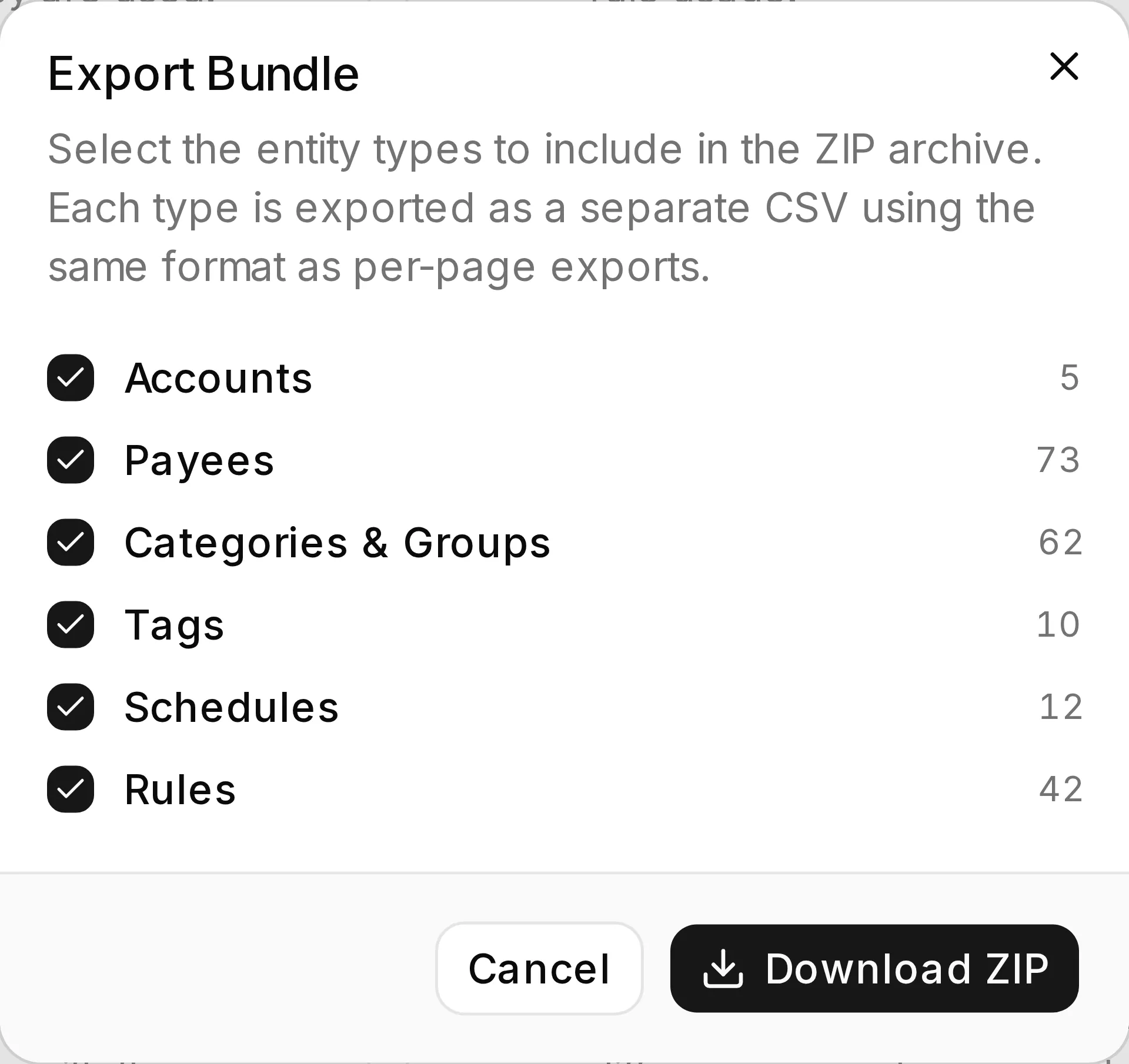
One ZIP, and it says exactly what is going into it before you download.
Why use a bundle?
Section titled “Why use a bundle?”Bundle Export / Import provides these functions:
- Everything at once - every entity type in one ZIP, each a CSV in the same format the per-page exports use.
- Import in the right order - by the time rules and schedules are read, the accounts, payees and categories they name are already staged.
- One undo step - the whole bundle stages together, and nothing is written until you Save.
Export a bundle
Section titled “Export a bundle”- On the Budget Overview, select Export.
- The dialog lists all six entity types with live counts and checkboxes (pre-selected). Deselect any you don’t want.
- Watch for dependency warnings as you change the selection:
- Selecting Rules without Payees, Categories, or Accounts warns that the export may not be portable.
- Selecting Schedules without Payees or Accounts warns the same way.
- Download to get a single ZIP,
budget-bundle-<label>-<YYYY-MM-DD>.zip.
The dialog fetches when it opens, so what you download is what the server holds right now.
ZIP contents:
budget-bundle-<label>-<date>.zip ├── accounts.csv ├── payees.csv ├── category-groups-and-categories.csv ├── tags.csv ├── schedules.csv └── rules.csvEach CSV carries the same columns as that entity’s own export. The entity guides list them.
Import a bundle
Section titled “Import a bundle”- On the Budget Overview, select Import and choose a
.zipproduced by Bundle Export. Partial bundles (a subset of the CSVs) are valid. - Review the preview - each detected entity type with its row count, before anything is staged.
- Confirm to stage. The order is fixed - categories, accounts, payees, tags, schedules, rules - so that schedules and rules find what they refer to, staged moments earlier in the same operation.
- Read the result summary: staged, skipped, and any parse errors, broken down by type. The links take you to each entity page to look at the staged rows.
- Click Save in the top bar to write everything. The entire bundle import is a single undo step.
Common problems
Section titled “Common problems”- A portability warning on export - you picked Rules or Schedules without what they point at. Include those types, or make sure the target budget already has matching names.
- Rows were skipped - the per-type summary says whether it was a parse error or an unmatched reference.
- Nothing changed - the rows are staged, not saved. Press Save.
Related pages
Section titled “Related pages”- Overview - where Export / Import live
- Editing, review and save - per-entity CSV import and export